Starting your journey in League of Legends can feel overwhelming. With over 160 champions to choose from, figuring out who to play in each role is one of the biggest hurdles new players face. The good news is that you do not need to master a mechanically demanding champion to climb ranks and have fun. In fact, playing simpler champions lets you focus on learning the fundamentals of the game — wave management, map awareness, objective control, and team fighting — without worrying about complex combos or precise timing windows.
In this guide, we have hand-picked three beginner-friendly champions for each of the five roles in League of Legends. These picks were chosen based on their straightforward kits, forgiving playstyles, and consistent effectiveness in solo queue throughout early 2026. Whether you are brand new to the game or looking to expand your champion pool with reliable picks, this list will help you find a champion that fits your style.
Top Lane
Top lane is the island of Summoner's Rift. You will spend much of the early game in extended one-on-one duels, so picking a champion that can hold their own without constant jungle help is essential. The following three champions are durable, deal respectable damage, and do not require flashy mechanics to be effective.
Garen
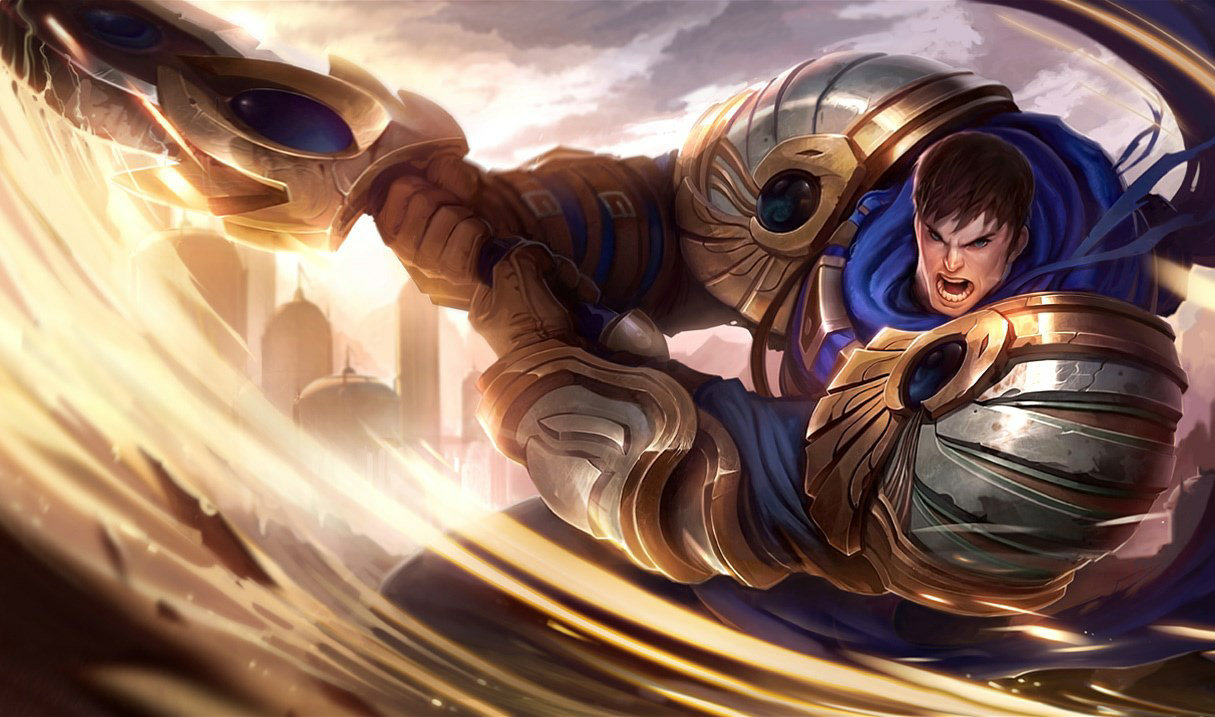
Garen has been the quintessential beginner top laner since the earliest days of League of Legends, and that has not changed in 2026. His kit is as straightforward as it gets: no mana bar, no skill shots, and a passive that regenerates his health when he stays out of combat. This means you can trade aggressively, back off, and heal up without needing to recall constantly.
Why he is good for beginners: Garen teaches you the fundamentals of top lane trading without punishing you for mistakes. His Courage ability (W) gives him a shield and damage reduction, making him very forgiving when you misposition. His ultimate, Demacian Justice, is a point-and-click execute that removes the guesswork from finishing off opponents. You can focus entirely on learning wave management, when to trade, and when to roam.
Core build approach: Garen thrives with a bruiser build. Start with a Doran's Shield for sustain in lane, then work toward Stridebreaker or Trinity Force as your core first item. Follow up with Dead Man's Plate for mobility and durability, then build situational tank items like Force of Nature against heavy magic damage teams or Randuin's Omen against critical strike-heavy compositions. Berserker's Greaves or Plated Steelcaps are your go-to boot choices depending on the matchup.
Gameplay tip: Use the brush to your advantage. Walk into a bush to drop minion aggro after a trade and let your passive start healing you. A common pattern is to activate Q for the movement speed boost, run at your opponent, silence them with the empowered auto attack, then immediately spin with E. Once they are low, finish with R. This simple combo is devastatingly effective at all levels of play.
Malphite
Malphite is the definition of a team fight-winning champion. His laning phase is simple and safe, and his ultimate, Unstoppable Force, is one of the most impactful abilities in the entire game. Even if you fall behind in lane, one well-placed ultimate in a team fight can single-handedly win the game.
Why he is good for beginners: Malphite's passive grants him a shield based on his maximum health, which regenerates out of combat. This gives you a safety net in lane. His Q is a point-and-click poke tool that also steals movement speed, making it easy to harass opponents. Most importantly, his ultimate is incredibly intuitive — you see enemies grouped up, you press R, and your team follows up. Learning to identify these moments teaches you one of the most valuable skills in League: team fight engagement timing.
Core build approach: Against physical damage opponents in lane, stack armor with items like Plated Steelcaps, Sunfire Aegis, and Frozen Heart. Malphite's abilities scale with armor, so building tanky actually makes you deal more damage. If you are against a magic damage opponent, consider starting with a Doran's Ring and building ability power items like Luden's Companion for a burstier playstyle. In most games, the full tank build is safer and more consistent for beginners.
Gameplay tip: Resist the urge to use your ultimate for anything other than multi-person engages in team fights. A Malphite ultimate that hits three or more enemies almost always results in a won fight. Be patient, wait for your team to be nearby, and look for the moment when the enemy carries are standing close together. Flash plus R extends your engage range dramatically and is one of the most reliable engage combos in the game.
Mordekaiser
Mordekaiser is a juggernaut who excels at sustained fights and isolated duels. His kit revolves around dealing magic damage in melee range and healing himself through combat, making him a formidable presence in the top lane. His ultimate, Realm of Death, pulls a single enemy into a one-on-one arena, which is perfect for removing a key threat from team fights.
Why he is good for beginners: Mordekaiser's abilities are all relatively simple to use. His Q is a straightforward area-of-effect slam, his W stores damage taken and dealt as a shield that can be consumed for healing, and his E is a pull that draws enemies toward him. He does not rely on complex combos or animation cancels. His sustain through W makes laning forgiving, and his ultimate gives you a clear objective in every team fight: pull the enemy carry into your realm and eliminate them.
Core build approach: Rush Riftmaker as your first major item for the sustained damage and omnivamp it provides. Follow up with Rylai's Crystal Scepter to make your passive slow enemies, ensuring they cannot escape your damage zone. Zhonya's Hourglass is an excellent third item for survivability. From there, build situational items like Spirit Visage for increased healing or Demonic Embrace for additional burn damage against tanky teams.
Gameplay tip: In team fights, identify the enemy's strongest carry and use your ultimate on them. Even if you do not kill them, removing them from the fight for seven seconds gives your team an enormous advantage. In lane, look to trade when your passive is about to activate — three ability hits or auto attacks trigger a damaging aura around you that also gives you movement speed, making extended trades heavily favor you.
Jungle
The jungle role can be intimidating for beginners because it requires knowledge of clear routes, gank timing, and objective control. These three champions have healthy clears, straightforward gank patterns, and kits that remain useful even when you fall behind.
Warwick
Warwick is widely considered the best champion for learning the jungle role. His kit is practically a tutorial for how jungling works. His W passive gives him movement speed toward low-health enemies, essentially telling you when and where to gank. His sustain through Q and passive healing means he stays healthy throughout his clear, and his ultimate is a long-range suppression that locks down a target for your team.
Why he is good for beginners: Warwick removes much of the decision-making difficulty from jungling. His Blood Hunt (W) highlights enemies below a health threshold on the map and gives you a massive movement speed boost toward them. This teaches you to watch the map for gank opportunities. His clear is healthy thanks to his innate lifesteal, so you do not need to worry about kiting camps perfectly. He is also strong in early skirmishes, which means you do not get punished as hard for running into the enemy jungler at river.
Core build approach: Blade of the Ruined King is an excellent rush item, giving Warwick attack speed, lifesteal, and a percentage-health damage passive that synergizes with his auto-attack-heavy kit. Follow up with Sundered Sky for burst and sustain, then transition into tank items like Spirit Visage (which amplifies all of your healing) and Dead Man's Plate. Mercury's Treads or Plated Steelcaps round out the build depending on the enemy team.
Gameplay tip: When ganking, hold your ultimate for when the enemy uses their escape ability. Many beginners waste Warwick's R at the start of a gank, only for the enemy to flash away first. Instead, run at them using W's movement speed boost, use Q to follow any dashes or flashes (holding Q rather than tapping it causes Warwick to follow the target's movement), and only use R if they get out of melee range or if you need to suppress them for your laner to catch up.
Amumu
Amumu is a tank jungler whose team fight impact is extraordinary for how simple his kit is. He has two charges of his Q, a skill-shot stun that doubles as a gap closer, an area-of-effect crying aura that deals percentage health damage, and an ultimate that stuns all nearby enemies. He has been a staple recommendation for beginner junglers for years, and for good reason.
Why he is good for beginners: Amumu's jungle clear is fast and healthy thanks to his W and E providing constant area-of-effect damage. His double-charge Q means missing one bandage toss is not as punishing as it used to be. In team fights, his role is simple: get into the middle of the enemy team and press R. A well-timed Amumu ultimate can stun an entire team, and even in low-ranked games where coordination is limited, teammates tend to follow up on such an obvious engage.
Core build approach: Build Amumu as a full tank. Sunfire Aegis is the ideal first item, amplifying your area-of-effect damage while making you tanky. Follow up with Jak'Sho, The Protean for additional resistances and sustain in prolonged fights. Thornmail is great if the enemy has heavy healing, and Abyssal Mask amplifies the magic damage your team deals to enemies near you. Finish with items like Randuin's Omen or Warmog's Armor depending on what you need.
Gameplay tip: When ganking, try to land your Q on the enemy laner from fog of war. Walk through the lane brush or come from behind the enemy if possible. In team fights, do not waste your ultimate on just one person unless that person is the enemy's primary carry. Ideally, flash into the enemy team and press R to hit as many champions as possible. Communicate to your team before engaging so they are ready to follow up.
Vi
Vi is a bruiser jungler who brings reliable ganks and strong single-target lockdown to any team. Her Q is a chargeable dash that knocks up enemies, and her ultimate is a point-and-click dash that suppresses a target. This combination makes her ganks nearly impossible to avoid when timed correctly, and she transitions into a solid frontline fighter in team fights.
Why she is good for beginners: Vi's ganks are simple and effective. You charge Q from fog of war, dash into the enemy, and follow up with auto attacks empowered by your W passive and E ability. If the enemy escapes your initial engage, your ultimate tracks them through flashes and dashes, making it one of the most reliable catch tools in the game. Her clear is also straightforward, with E providing area-of-effect damage for multi-camp efficiency and her passive shield keeping her healthy.
Core build approach: Trinity Force or Eclipse make excellent first items, giving Vi the damage and dueling power she needs to dominate the mid game. Follow up with Sterak's Gage for a massive shield in team fights and additional attack damage. From there, build tank items based on the enemy team: Dead Man's Plate for armor and mobility, Force of Nature for magic resistance, or Guardian Angel if you are ahead and want to play aggressively in fights.
Gameplay tip: Always path toward the lane you want to gank. Vi is at her strongest between levels three and six, so plan your first clear to end on the side of the map where you can gank the most vulnerable enemy lane. After level six, look for picks before major objectives. Ulting an out-of-position enemy carry before Dragon or Baron spawns gives your team a numbers advantage to secure the objective.
Mid Lane
Mid lane is the center of the map, giving you the most influence over the rest of the game. These three champions are straightforward, deal consistent damage, and have tools to survive the often-aggressive mid lane environment.
Annie
Annie is the original beginner mid laner and remains one of the best champions for learning fundamental mid lane skills in 2026. Her abilities are simple, her burst damage is enormous, and her passive stun mechanic teaches you about resource management in a visual and intuitive way.
Why she is good for beginners: Every four spell casts, Annie's next offensive ability stuns the target. This stun counter is displayed clearly on your buff bar, making it easy to track. Her Q refunds its mana cost and a portion of its cooldown when it kills a target, which makes farming in lane very forgiving. When you have your stun ready and your ultimate available, walking up and pressing R on grouped enemies drops a giant bear on them while stunning everyone in the area. This combo has won more games at every skill level than almost any other ability in the game.
Core build approach: Rush Luden's Companion for wave clear and burst damage. Follow up with Shadowflame for magic penetration and increased damage to low-health targets, then build Rabadon's Deathcap for a massive ability power spike. Zhonya's Hourglass is an excellent pickup if you are against assassins, and Banshee's Veil works against heavy magic damage. Sorcerer's Shoes are the standard boot choice for maximum damage output.
Gameplay tip: Do not blow your stun randomly. Keep it charged and use the threat of your stun to zone enemies away from minions. When your stun is ready and you have your ultimate, you have kill pressure on almost any mid laner. Flash plus Tibbers with stun is one of the most devastating level-six power spikes in the game. Practice this combo in practice tool until it feels natural. In team fights, look for opportunities to flash-R onto multiple enemies, similar to how Malphite uses his ultimate.
Veigar
Veigar is a scaling mage whose ability power grows infinitely throughout the game. Every time you hit an enemy champion with an ability or kill a minion with your Q, you gain permanent ability power. This means that even if your laning phase goes poorly, you will eventually become a late-game monster capable of one-shotting squishy targets.
Why he is good for beginners: Veigar's farming pattern is simple: last-hit minions with Q to stack your passive. This naturally teaches you the important skill of last-hitting while also rewarding you for doing it well. His E places a cage on the ground that stuns any enemy who touches the walls, which is one of the best zone-control abilities in the game and is easy to place effectively in choke points. His ultimate is a point-and-click nuke that deals more damage based on how much health the target is missing, making it an incredibly satisfying execute.
Core build approach: Start with a Doran's Ring for mana sustain, then rush Luden's Companion for wave clear and burst. Shadowflame and Rabadon's Deathcap amplify your already-growing ability power to absurd levels. Zhonya's Hourglass gives you survivability, and Void Staff ensures you can damage even magic resistance-stacking tanks. Sorcerer's Shoes are standard, though you can opt for Ionian Boots of Lucidity if you prefer more frequent ability casts.
Gameplay tip: Focus on farming safely in the early game rather than trying to fight your lane opponent. Veigar is weak before he accumulates enough stacks, so overextending early will get you killed. Place your E cage defensively when enemy junglers gank you, cutting off their approach path. In team fights, drop your cage on choke points to zone enemies, then use your combo on anyone caught inside. Save your ultimate for targets below half health to ensure the kill.
Lux
Lux is a long-range burst mage with crowd control, a shield, and powerful wave clear. She can be played in both mid lane and support, making her a versatile champion to learn. Her kit rewards good aim with her skill shots but is not overly punishing if you miss, thanks to her low cooldowns and safe range.
Why she is good for beginners: Lux can contribute to fights from a very safe distance. Her Q is a root that binds up to two enemies, her W is a shield that protects herself and allies, and her E is an area-of-effect slow and damage zone. Her ultimate is a long-range beam that deals heavy damage on a relatively low cooldown, especially with ability haste items. This range advantage means you rarely need to put yourself in danger, which is invaluable while you are still learning positioning.
Core build approach: Luden's Companion is the standard first item for wave clear and burst. Follow up with Shadowflame and Rabadon's Deathcap for maximum damage. Horizon Focus pairs well with Lux since she frequently initiates combos from long range with her Q root. Zhonya's Hourglass is the go-to defensive option. Sorcerer's Shoes are the standard boot choice for damage-focused builds.
Gameplay tip: Your full combo is Q (root) into E (placed on top of the rooted target) into ultimate (fired through both), then detonate E. This burst sequence can kill squishy targets from full health in the mid and late game. In lane, use E to poke and push the wave simultaneously. When you hit a Q root, always follow up with your full combo for maximum damage. Ward river and play toward the side of the lane where your jungler is for safety.
ADC (Bot Lane Carry)
The ADC role revolves around dealing consistent physical damage from range, particularly in the late game. These three champions have straightforward kits that let you focus on the core ADC skills of farming, positioning, and auto-attacking.
Miss Fortune
Miss Fortune is arguably the best ADC for beginners in 2026. She has strong laning phase, easy-to-use abilities, and one of the most devastating team fight ultimates in the game. Her passive, Love Tap, deals bonus damage when she switches targets between auto attacks, which naturally encourages good ADC habits of target switching in fights.
Why she is good for beginners: Miss Fortune does not rely on complex mechanics. Her Q bounces between two targets and deals massive damage when the first target dies, teaching you about minion positioning. Her W gives her a movement speed boost that helps with repositioning. Her E slows an area. And her ultimate, Bullet Time, channels a barrage of bullets in a cone that shreds through entire teams when positioned well. She does not have a dash or blink, which forces you to learn proper positioning from the start rather than relying on escape tools as a crutch.
Core build approach: Rush The Collector or Essence Reaver for a strong first-item power spike. Follow up with Infinity Edge for critical strike amplification and Lord Dominik's Regards for armor penetration. Rapid Firecannon extends your auto attack range for safer poke. Berserker's Greaves are the standard boot choice. In games where you need sustain, Bloodthirster is a solid pickup.
Gameplay tip: Position your ultimate carefully in team fights. Bullet Time channels for three seconds and deals enormous damage, but you can be interrupted by crowd control. Wait for the enemy team to use their key abilities before channeling, or position from an angle where enemies do not expect you. In lane, use Q to poke through dying minions — the bounce does extra damage and can chunk enemy carries from a safe distance.
Ashe
Ashe is a utility-focused ADC whose kit brings crowd control, vision, and consistent damage to any team composition. Her passive slows enemies with every auto attack, making it nearly impossible for targets to escape her. Her ultimate, Enchanted Crystal Arrow, is a global stun that can initiate fights from anywhere on the map.
Why she is good for beginners: Ashe's constant slowing auto attacks make kiting (attacking while moving backward) much easier because enemies struggle to reach you. Her E, Hawkshot, sends a global vision bird across the map, teaching you about vision control and information gathering. Her W is a wide volley that is easy to hit for poke. And her ultimate provides engage potential that is usually reserved for tanks and supports, giving your team flexibility. These qualities make Ashe valuable even in games where you fall behind in farm.
Core build approach: Blade of the Ruined King is a common rush item for Ashe, providing attack speed, lifesteal, and a percentage-health passive that pairs well with her consistent auto attacks. Follow up with Kraken Slayer for additional on-hit damage, then build Runaan's Hurricane to spread your slowing auto attacks across multiple targets in team fights. Infinity Edge amplifies your critical strike damage substantially. Berserker's Greaves are the standard boot choice.
Gameplay tip: Use Hawkshot frequently to scout objectives like Dragon and Baron before your team moves to contest them. Information wins games, and many beginners forget that Ashe has this powerful scouting tool on a relatively short cooldown. In team fights, stay as far back as possible and auto attack whoever is closest to you. Do not tunnel onto the enemy carry if it means stepping into danger. Your slowing auto attacks and consistent damage will carry fights as long as you stay alive.
Jinx
Jinx is a hypercarry ADC who becomes increasingly powerful as fights progress. Her passive, Get Excited, grants her massive movement speed and attack speed whenever she gets a kill or assist, allowing her to snowball through team fights. She has two auto attack modes: a shorter-range minigun for fast single-target damage and a longer-range rocket launcher for area-of-effect damage.
Why she is good for beginners: Jinx's kit teaches you about attack range management and positioning through her Q toggle. Her W is a long-range slow that helps with kiting, and her E places traps that root enemies who step on them, providing peel against divers. Her ultimate is a global rocket that executes low-health enemies anywhere on the map, providing some of the most exciting moments in the game. While she lacks a dash, her passive ensures that once a fight starts going in your favor, you become nearly unstoppable.
Core build approach: Rush Infinity Edge for raw critical strike damage, then build Rapid Firecannon for extended range on rocket-launcher auto attacks. Runaan's Hurricane is excellent for Jinx because the bolts apply her rocket launcher splash damage, melting grouped enemies. Lord Dominik's Regards helps against tanks, and Bloodthirster provides sustain. Berserker's Greaves are essential for the attack speed they provide.
Gameplay tip: In the laning phase, switch between minigun and rocket launcher based on the situation. Use rockets to poke enemies when they go for last hits, but switch to minigun when farming to conserve mana and build up your attack speed stacks. In team fights, start with rockets for the area damage and range advantage, then switch to minigun if a target gets close or you need maximum single-target DPS. Always watch the map for low-health enemies across the map to snipe with your ultimate.
Support
Supports control vision, protect their carry, and enable their team through crowd control and utility. These three champions are effective, easy to learn, and will teach you the fundamentals of the support role.
Leona
Leona is a tank engage support with one of the highest amounts of crowd control in the game. She has a root, a stun, and an area-of-effect stun on her ultimate. When Leona decides to go in, enemies are locked down for an extended period, giving your team ample time to follow up and secure kills.
Why she is good for beginners: Leona's playstyle is straightforward: wait for the right moment, then go all-in with your crowd control chain. She is naturally tanky thanks to her W, which grants bonus armor and magic resistance. Playing Leona teaches you about engage timing, vision control (you need to position in brush to threaten engages), and target selection. Her kit does not have any complex mechanics — you E into an enemy, Q to stun them, and press W before engaging for the damage reduction.
Core build approach: Start with Relic Shield for gold generation and lane sustain. Rush Locket of the Iron Solari for the team-wide shield it provides, which can turn fights in your favor. Follow up with Knight's Vow to protect your ADC, and Zeke's Convergence to amplify their damage. Build additional tank items like Frozen Heart or Force of Nature based on the enemy team's damage profile. Boots of Swiftness or Plated Steelcaps are both solid boot choices.
Gameplay tip: Do not engage unless your ADC is in a position to follow up. The most common mistake beginner Leona players make is engaging when their carry is farming under tower or too far away to deal damage. Ping before you go in, make sure your ADC has the mana and health to fight, and then commit. Once you go in as Leona, you are committed — she has no way to disengage, so make sure the fight is winnable before you press E.
Lulu
Lulu is an enchanter support who excels at protecting her allies and disrupting enemies. Her kit is packed with utility: a slow and poke tool in Q, a buff or polymorph in W, a shield and vision-granting ability in E, and an ultimate that gives an ally bonus health and knocks up nearby enemies. She is the quintessential protective support.
Why she is good for beginners: Lulu's abilities are point-and-click for the most part, making her easy to use effectively. Her W, Whimsy, can either speed up an ally or turn an enemy into a harmless critter for a brief duration, which is one of the strongest basic abilities in the game for stopping assassins and divers. Her ultimate is a panic button that saves allies from death while disrupting nearby enemies. Playing Lulu teaches you to watch your teammates' health bars and react to threats, which is the core skill of a support player.
Core build approach: Start with Spellthief's Edge for gold generation and poke damage. Rush Moonstone Renewer for sustained healing in team fights, or Staff of Flowing Water if your team has multiple ability power carries. Ardent Censer is an excellent purchase when your ADC is auto-attack focused, as your shields and heals grant them bonus attack speed. Redemption provides an additional team heal, and Mikael's Blessing removes crowd control from an ally. Ionian Boots of Lucidity are standard for the ability haste.
Gameplay tip: Save your W polymorph for the biggest threat to your carry. Do not use it offensively to poke in lane unless you are certain the enemy cannot engage on your ADC while it is on cooldown. In team fights, your priority order is usually: R your carry if they are being dove, W the enemy assassin or diver, E your carry for a shield, and Q to slow anyone chasing your team. Always position behind your frontline and focus on keeping your damage dealers alive rather than dealing damage yourself.
Nautilus
Nautilus is a hook-based tank support who brings an absurd amount of crowd control to the bot lane. His passive roots enemies on his first auto attack against each target, his Q is a hook that pulls both him and the target together, his E slows enemies around him, and his ultimate is a point-and-click knock-up that also knocks up everyone the projectile passes through on its way to the target.
Why he is good for beginners: Nautilus's hook hitbox is notoriously generous, making it much easier to land than similar abilities on champions like Thresh or Blitzcrank. Even if you miss your hook, you can still engage effectively by walking up and using your passive root combined with your E slow. His ultimate is point-and-click, removing the possibility of whiffing your most important ability. He teaches you about lane pressure, bush control, and engaging at the right moment, all of which are fundamental support skills.
Core build approach: Start with Relic Shield for sustain and gold. Rush Locket of the Iron Solari for the team shield, then build Zeke's Convergence to buff your carry's damage during engages. Knight's Vow is a strong third item to protect your ADC. Round out the build with situational tank items like Frozen Heart against attack-speed-heavy teams or Force of Nature against magic damage. Mercury's Treads are valuable for reducing crowd control duration, while Plated Steelcaps help against physical damage.
Gameplay tip: In lane, stand in the brush and threaten hooks. The pressure of a potential Nautilus hook forces enemies to play cautiously and miss farm, even if you never actually throw the ability. When you do land a hook, immediately auto attack for the passive root, then use E to slow, giving your ADC plenty of time to deal damage. Layer your crowd control rather than using it all at once: hook first, then auto-attack root, then E slow. Save your ultimate for chasing targets or peeling for your carry in team fights.
Final Thoughts
Learning League of Legends is a marathon, not a sprint. By picking champions from this list, you give yourself the freedom to focus on macro-level skills that will carry you through every rank: map awareness, objective prioritization, wave management, and team fight positioning. Mechanical complexity can come later once you have a strong foundation.
Remember that mastering one or two champions in your main role will always yield better results than constantly switching between dozens of champions. Pick the one that feels the most natural to you from each role, practice them consistently, and you will see steady improvement in your gameplay throughout 2026.
Find Your Ideal Champion
Use our recommender to find the perfect pick for your next ranked game.
Try LoLSuggest